
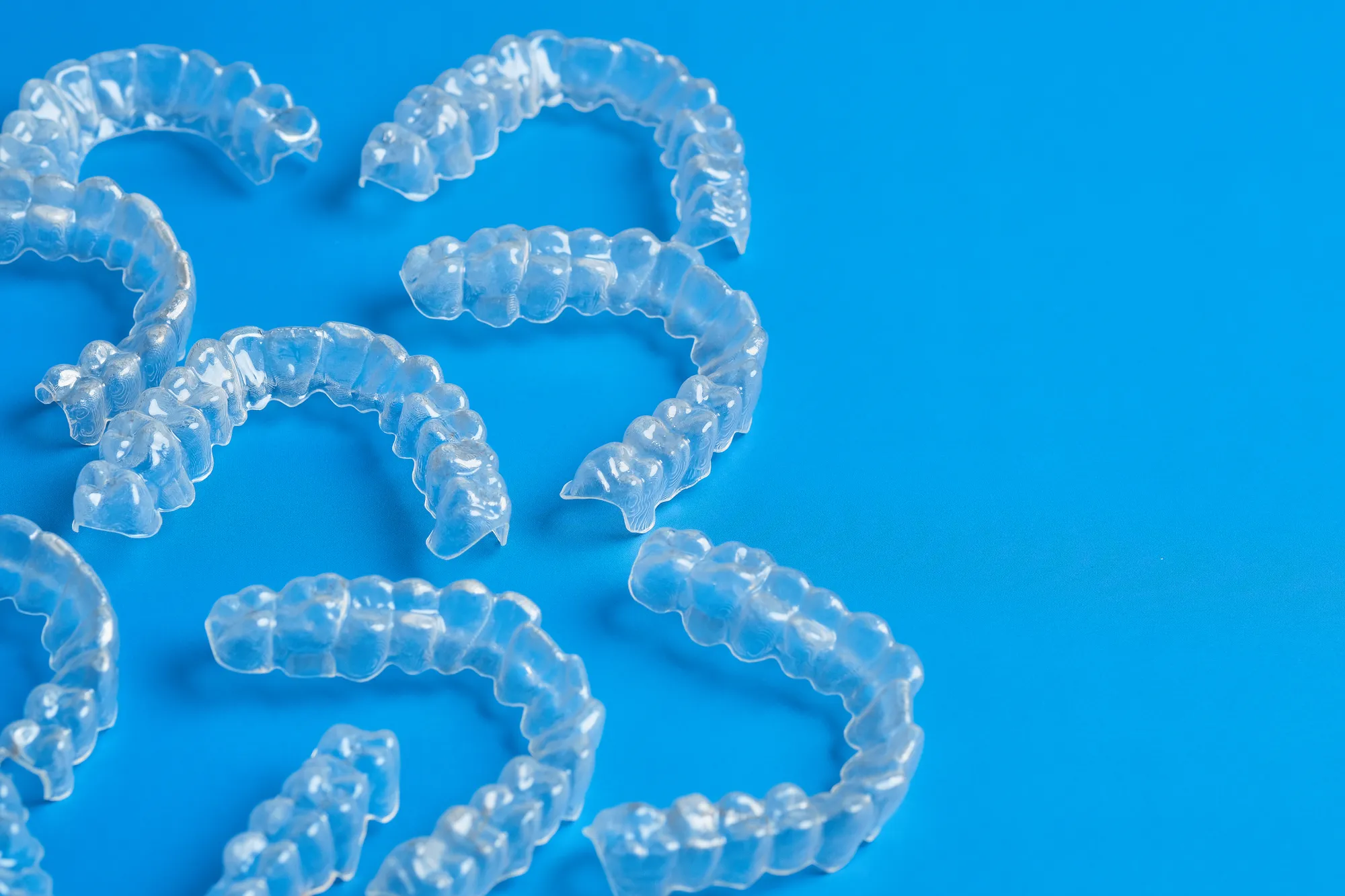
| Clear aligners are the most discreet orthodontic solution available today: almost invisible, removable aligners that straighten crooked teeth without wires or metal brackets. In this article, we explain how they work, who is eligible for treatment, how long the treatment takes and what the process is like at Olbia Dental Studio — where you can see the final result on your smile even before you start. |
Summary
What are clear aligners
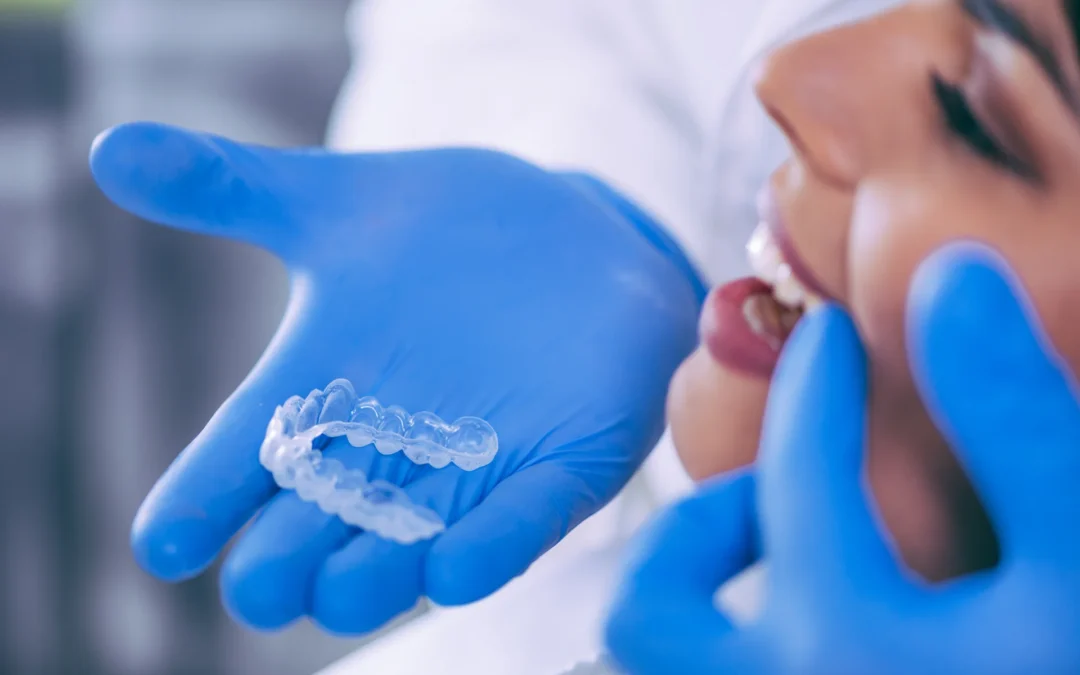
Clear aligners are thin trays made from biocompatible thermoplastic material, custom-made based on a precise digital scan of your mouth. They are worn directly on the dental arches, fitting perfectly against the surface of each tooth. The principle is the same as that of traditional braces — moving the teeth into the correct position through gradual, controlled pressure — but the difference compared to fixed brackets is significant: aligners are almost invisible and, above all, removable.
The difference that is seen - and that which is not seen
Discreetness is the most obvious benefit. But the feature that truly transforms your experience of treatment is that they are removable. With clear aligners, you can eat normally, brush your teeth as usual, and take them out for a photo, an important meeting or a special occasion. This freedom completely changes the experience of orthodontic treatment — especially for those with an active social or professional life.
How they work: the logic of progressive changes
The treatment is based on a sequential series of aligners, each one slightly different from the previous one. Each aligner is worn for around one or two weeks, then replaced with the next one. Each change corresponds to a movement planned in advance, one hundredth of a millimetre at a time, until the desired final position is reached. The combination of all these movements — designed digitally even before treatment begins — moves the teeth into the correct position within the timeframe set out in the treatment plan.
The role of attachments
In some cases, the dentist applies a tooth-coloured biomaterial to the teeth, creating what are known as attachments. Virtually invisible, these serve to provide anchor points for the aligner when tooth movement requires forces in specific directions: rotations, extrusions and root movements. They are not always necessary. When they are required, they make the treatment more precise and do not alter the appearance of the aligner in any way once it is worn.
Who they are for: ideal cases and limits
Clear aligners are effective at correcting most mild and moderate malocclusions:
- Dental crowding: overlapping, rotated or crooked teeth
- Diastemas: gaps between the teeth, including the gap between the central incisors
- Open anterior bite
- Deep bite
- Lateral crossbite
- Misalignments and slight asymmetry of the dental arches
Are there cases where aligners aren't enough?
Yes. In cases of very complex malocclusions — marked tooth movement, significant skeletal discrepancies, or the need for multiple extractions — aligners alone may not be the most suitable solution. In such cases, combined treatment approaches are considered, or a fixed brace is chosen. This assessment always takes place during the first appointment. At
At Olbia Dental Studio, every case is analysed thoroughly before any treatment plan is proposed: no solution is
the same for everyone.
Are you an adult who's put off orthodontic treatment for years? Find out why it's never too late to have a beautiful smile.
The care journey at Olbia Dental Studio
The process is divided into clearly defined stages and
precise timing. Each step is designed to ensure the best possible result with the least possible discomfort.
First visit and clinical assessment
During your first visit, we assess the general health of your mouth, the condition of your gums and the position of your teeth. If necessary, we take a panoramic X-ray, some small digital X-rays and photographs. Periodontal health is an essential prerequisite: before starting any orthodontic treatment, your mouth must be in excellent condition. At this stage, we explain clearly what we can correct, how long it will take and what the treatment plan involves. You will receive a detailed quote with the payment options best suited to your needs.
3D scanner and digitised treatment plan
At Olbia Dental Studio, we use a 3D intraoral scanner to capture a precise digital impression of your entire mouth. No impression paste, no mouthwash, no plaster casts. The scan takes just a few seconds and produces a three-dimensional model with absolute precision. The complete treatment plan is built around this model: every movement of every tooth, from the start to the end of treatment, is planned digitally even before you put on your first aligner.
Therapy: aligners, change and checks
Once the treatment plan has been approved, you will receive your first set of aligners, along with detailed written instructions. Regular check-ups take place every 4 weeks and last an average of 15–20 minutes: these are to check that your teeth are moving as planned and to provide you with the next set of aligners.
The retainer
Once orthodontic treatment is complete, the teeth need to be stabilised in their new position. This is the most frequently underestimated stage of orthodontic treatment — yet it is essential for maintaining the results over time. The retainer — a thin, clear aligner to be worn at night — is included in the treatment plan and is provided at the same time as the final aligners.
3D simulation: see the result before you start
One of the most daunting aspects of orthodontics is uncertainty: not knowing exactly what you’ll look like at the end of treatment. Digital smile simulation tackles this problem at its root. With Olbia Dental Studio"s planning software, you can see the final position of your teeth on the screen even before you put on your first aligner.
You can approve the proposed outcome, request changes or compare different treatment options. You’ll start treatment knowing exactly what the end result will be.
This approach is not only reassuring: it is also clinically more precise. Each aligner is manufactured in accordance with the digital treatment plan, with movements calibrated to the nearest hundredth of a millimetre. Nothing is left to chance.
The duration of treatment with clear aligners varies, typically ranging from 6 to 24 months. This depends on the complexity of your dental issues and the extent of correction required. Your orthodontist will provide a more precise estimate after an initial consultation.
The duration depends on the complexity of the case and how consistently the aligners are worn. The aligners must be worn for at least 20–22 hours a day. The remaining 2–4 hours are set aside for meals, snacks and oral hygiene. Adherence is crucial: the fewer hours they are worn, the greater the risk of prolonging the treatment time.
- Mild cases (minor misalignments, limited diastemas): 3–6 months
- Moderate cases (crowding, bite requiring correction): 6–12 months
- Complex cases (severe malocclusions): 12–24 months
Thanks to 3D simulation and the expertise of Dr Riccardo Masia, a specialist in orthodontics, you can find out the estimated duration of treatment as early as your first appointment.
Clear aligners: how much do they cost in Olbia
The cost of treatment varies depending on the complexity of the malocclusion, the duration of treatment and the number of aligners required. It is impossible to give a fixed price without a clinical assessment: two people with “crooked” teeth may have very different cases.
As a rough guide, full courses of treatment with aligners start at around 3,000 euros for mild cases and can reach 5,000–6,000 euros for more complex cases. These prices include digital diagnostics, a 3D scan, all aligners in the series, check-ups and a retainer.
At Olbia Dental Studio, you can pay in small, convenient monthly instalments, subject to immediate approval. Orthodontic costs are also tax-deductible under the 19% scheme.
Domande frequenti sugli allineatori trasparenti
How many hours a day should the aligners be worn?
Clear aligners must be worn for at least 20–22 hours a day to ensure the treatment is effective. The remaining 2–4 hours are set aside for meals and oral hygiene. Consistency at this stage is crucial: every hour of wear missed adds to the delay, which can significantly extend the overall duration of treatment.
Do clear aligners hurt?
They don’t hurt in the traditional sense. In the first few hours after each aligner change, you may feel a slight tightness on your teeth — and that’s normal; it’s a sign that the aligner is working. This sensation usually disappears within 24–48 hours.
Can I eat normally with aligners?
Yes — and this is one of the most appreciated differences compared to fixed braces. You take the aligners out before eating and put them back in after brushing your teeth. No forbidden foods, no risk of breakage or staining. You can eat exactly what you want, with no restrictions.
What happens at the end of the treatment?
Once active treatment has finished, the patient moves on to the retention phase, wearing a clear retainer mainly at night. This helps to stabilise the teeth in their new position whilst the supporting tissues adapt permanently. Skipping this phase is the main cause of orthodontic relapse — the gradual return of the teeth to their original position.



 Italiano
 English (UK)
 Español
 Română
 Русский
 Sardu
Sardu