
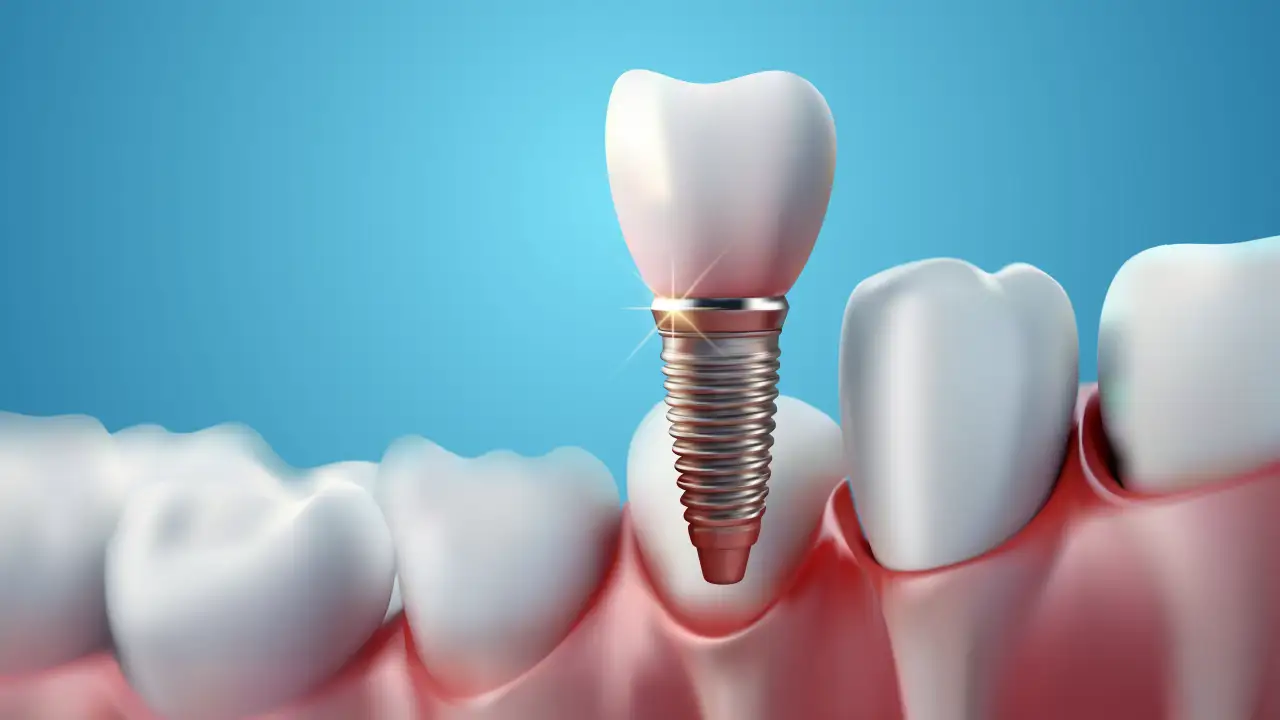
Dental implants are currently the best solution for replacing one or more missing teeth. Thanks to digital technologies Implantology today is more precise than ever, quick and comfortable.
In this article we discover How do dental implants work in Olbia at Olbia Dental StudioWhen needed, stages of treatment, costs, and benefits of immediate load implants.
Summary
Dental implants: what they are, when they are needed and how they work
Losing one or more teeth can seem like a difficult obstacle to overcome, but today dental implants offer safe and effective solutions.
Dental implants allow you to regain fixed, beautiful, and functional teeth, even in as little as 24 hours. If you're reading this article, it means you have doubts or questions about this treatment and want a clear explanation, without technical jargon.
In these lines, you will find all the useful information to understand how the systems work, when they are needed, and what to expect from the process at Olbia Dental Studio.
Summary
- What is a dental implant
- When to consider a dental implant
- The stages of the implant process
- First visit and digital diagnostics
- 3D planning and surgical guide
- Intervention and conscious sedation
- Temporary and definitive prosthesis
- Technologies that reduce discomfort
- Recovery and post-operative
- How much does a dental implant cost in Olbia?
- Alternatives to implants
What is a dental implant
One dental implant It's a small Titanium vite biocompatibile which replaces the root of a missing tooth. Once inserted into the jawbone or mandible, the implant naturally integrates through a process called osseointegration. This means it becomes part of the body, providing stability and security just like a natural root.
The crown (the artificial tooth) is then applied to the visible part of the implant, restoring aesthetics, functionality and comfort.
Not all dental implants are the same
Modern plants have Designed to meet different needs, such as varying bone availability or positioning type..
Furthermore, input methods have also evolved significantly in recent years. Thanks to digital technologies, it is now possible to plan an intervention on a virtual model of the patient's mouth so as to make the execution fast and without unforeseen events.
At Olbia Dental Studio we exclusively use certified systems state-of-the-art, designed for maximum durability and a completely natural look.
When to consider a dental implant
Dental implants represent the ideal solution when It is no longer possible to save a compromised tooth from deep decay, fractures, advanced periodontitis, or following an extraction.
Implants only when necessary: the ethical choice of Olbia Dental Studio
At Olbia Dental Studio Implants are only used when treatments to preserve natural teeth are superfluous because they are unsuitable for the clinical condition.
In other words, in our Dental studio in Olbia, Teeth that can still be treated are never “replaced a priori”. Our philosophy is to safeguard our patients' natural teeth whenever possible..
Is your removable denture uncomfortable and slips? Choose immediate load implantology
Implants can be a solution even if you wear a A removable prosthesis that moves and causes discomfort or requires the use of adhesives. Thanks to’immediate load implantology, if suitable*, you can smile and chew again without difficulty on the same day.
Thanks to immediate loading, many of our patients, after years of wearing dentures, have rediscovered the joy of eating with confidence and showing themselves in public without the fear of their prosthesis moving during a meal or a conversation.
The stages of the implant process
The’dental implant placement It is a safe, quick and painless procedure if performed by expert hands. At Olbia Dental Studio We follow a precise protocol that puts the patient's health and well-being at the centre.
- First visit: Diagnostic examinations and preliminary oral hygiene ensure that the mouth is ready for the procedure.
- 3D digital planningLet's assess the bone that will host the implant or implants and study the case in every detail.
- Operating Phase Lasts 20–30 minutes on average using minimally invasive techniques and, if necessary, conscious sedation to calm anxiety and ensure a comfortable recovery.
- Post-operative after the implant has been inserted, it is a temporary or permanent prosthesis has been fitted, as appropriate.
- Follow-up: The process is completed with routine checks, to ensure a stable and lasting result.
First visit and digital diagnostics
The first visit is a fundamental moment: it's for getting to know your needs and assessing the general health of your mouth.
We use advanced digital tools, such as Low-dose 3D TAC and intraoral scanner, which allow us to analyse the bone and optimal implant position with extreme precision..
This phase reduces the margin for error and increases treatment safety as the radiation rate is very low.
3D planning and surgical guide
Thanks to digital planning, we can simulate the procedure in advance and predict the aesthetic and functional outcome. The surgical guide (or template) is designed on a computer and 3D-printed, allowing the implant to be inserted with maximum precision. This approach minimises discomfort and makes the procedure quicker and safer.
Intervention and conscious sedation
The procedure is carried out in a sterile room, following painless local anaesthesia. In most cases, it lasts approximately 20–30 minutes. After the operation, we recommend only a few hours of rest and a soft diet for the first day. Many patients tell us they return to their normal activities the very next day with minimal discomfort. For those suffering from dental anxiety, conscious sedation is available, administered by an experienced anaesthetist, which makes the experience even more serene.
Temporary and definitive prosthesis
In some cases, such as with front teeth, an aesthetic temporary prosthesis can be inserted immediately, so as not to leave any gaps. For full arches, when bone conditions allow, we adopt immediate loading, positioning a temporary prosthesis within 24 hours. After approximately 3 months, when the implant is stably osseointegrated, the definitive prosthesis, custom-designed for aesthetics and functionality, is made and delivered.
Technologies that reduce discomfort
Modern dental implantology allows treatment to be approached with great confidence, thanks to technologies that minimise discomfort.
TAC 3D and intraoral scanner for precise, rapid, and comfortable interventions
At Olbia Dental Studio, we use the latest generation of instruments: a low-dose 3D CT scanner and a digital intraoral scanner allow for precise, non-invasive diagnoses. Computerised planning and surgical guides enable extremely accurate implant placement, reducing time and discomfort.
Conscious Sedation: reducing post-operative anxiety and pain
The environment in which the procedure takes place is also important: each operating room is prepared according to strict sterility protocols, to ensure maximum safety. The use of certified and biocompatible materials ensures durability and reliability.
Finally, the ability to run the conscious sedation This makes the experience calm, even for those who are afraid of the dentist. All of this translates into rapid, minimally invasive procedures with a surprisingly light post-operative recovery.
Recovery and post-operative
Recovery after dental implant surgery is generally very fast..
In most cases, patients experience only mild discomfort in the first few hours, which can be easily managed with common painkillers. It is advisable to apply ice locally and follow a soft diet on the same day (yoghurt, pureed soups, soft fruits).
Often, from the very next day, it is possible to resume normal daily activities, including work..
At Olbia Dental Studio, we always provide personalised oral hygiene instructions and schedule regular check-ups to monitor healing and osseointegration.
In most cases, within a few weeks you'll even forget you have an implant, because the sensation is entirely natural, like having a real tooth.
Risks and possible contraindications
Dental implants are a safe and predictable treatment, with very high success rates.
Absolute contraindications are rare and concern growing patients (Children and adolescents), pregnant women, and those with particular conditions such as bone metastases or specific therapies with particular drugs.
In most cases, conditions such as
- diabetes
- Heart disease
- Allergy
they do not represent an obstacle, if managed correctly.
The most common complications include failure of osseointegration (very rare, affecting fewer than 1% of cases), which can be easily resolved with a new insertion, and mucositis, an inflammation of the gums that can be prevented with proper hygiene.
More serious, but also rare, is peri-implantitis, which is managed with regular check-ups and hygiene..
It is worth noting that the so-called “Implant rejection” doesn't exist.: Pure titanium is biocompatible and does not cause allergic reactions.
How much does a dental implant cost in Olbia?
Speak of costs in implantology means to be clear and transparent. The price can vary based on several factors:
- the number of teeth to be replaced,
- the quantity and quality of bone available,
- the need for bone regeneration,
- the type of materials chosen for the definitive prosthesis.
Indicative costs of dental implants in Olbia: single tooth and full arch
- Indicatively, a A single system can cost between €1,600 and €2,900., depending on the complexity of the case.
- For a full arch, the cost can range from €8,000 to €18,000.. These figures include the entire process: diagnostic tests, surgery, potential anaesthetist, and temporary and permanent prostheses.
To make investing more accessible, we offer various payment methods:
- Funding up to 60 months,
- Zero-interest solutions with immediate approval
- the possibility of claiming the 19% tax deduction as a medical expense.
Smile health is a precious asset and deserves to be planned without surprises.
Alternatives to implants
Dental implants are not the only solution for replacing missing teeth, although today they represent the most stable and durable one. The most common alternatives are dental bridges and removable dentures.
- Bridges, fixed to adjacent natural teeth, allow for the replacement of one or more teeth., but they require filing down adjacent healthy teeth, which is something we try to avoid today.
- Removable prosthetics, conversely, can be full (the classic denture) or partial, but often they are uncomfortable, unstable and require adhesives to remain stationary.
In contrast, implants offer fixed, functional, and aesthetically natural teeth, without involving other teeth and without the risk of the prosthesis moving. Therefore, when conditions allow, they represent the treatment of choice for regaining confidence, chewing ability, and a smile.
Do you want to know if Dental implantology in Olbia Is it the right solution for you? Book a free initial consultation at Olbia Dental StudioOur team will assess your situation and guide you step by step towards a new, stable, and confident smile.



 Italiano
 English (UK)
 Español
 Français
 Română
 Русский
 Sardu
Sardu